When we told everyone we were leaving the city, they laughed. My parents called it a phase, my friends said I’d regret it, and her family warned us never to come crawling back when “reality” hit.
Reality did hit. The first winter almost broke us—frozen pipes, sick calves, and mornings so cold we couldn’t feel our hands through the gloves. Nights we went to bed exhausted, muscles aching, wondering if they’d been right all along.
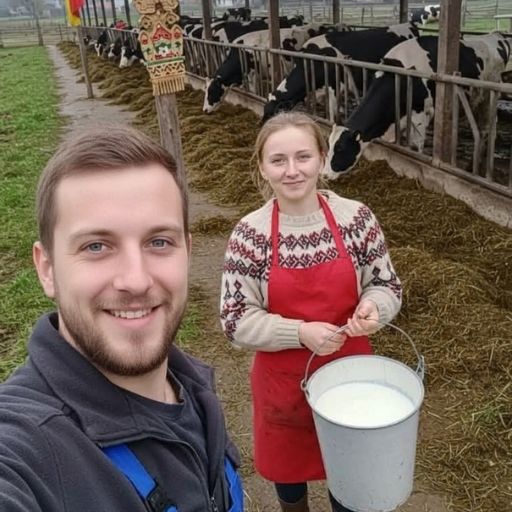
But then spring came. The land woke up. We learned how to listen to the rhythm of it—the cows, the soil, even the silence between chores. She smiled differently out here, with hay in her hair and a bucket of fresh milk in her arms. And I started smiling too, not the forced kind for office meetings, but the kind that sticks.
Now, it’s been four years since we traded elevators for tractors. Sometimes I still catch myself remembering what it was like to stare out of a 15th-floor window at a skyline that never slept. Back then, I thought that was life—bright lights, promotions, and Friday nights where you drink just enough to forget how much you hate Monday mornings.
Out here, Monday mornings smell like dew and fresh grass. The cows wait for you, whether you’re in the mood or not. They don’t care about your excuses, and maybe that’s the beauty of it. You learn discipline, not because a boss tells you to, but because life depends on it.
Of course, it wasn’t smooth sailing. Money was tight, tighter than we ever imagined. We sold the little car we had brought with us from the city just to afford new roofing for the barn after a storm tore it apart. I remember us sitting in that cold kitchen, eating soup made from scraps, joking about how our “luxury dining” was served in chipped bowls. Those jokes kept us sane.
Neighbors were another story. At first, they didn’t quite know what to make of us. Two city kids with soft hands pretending they could run a farm? We were the punchline at the local diner. I overheard one of them once, saying, “Give them two seasons, and they’ll be gone.”
But we stayed. Not because we were stubborn, but because we started falling in love with the work. She would hum while feeding the calves, and I’d find myself staring at her like it was the first time I’d ever seen her. Something about the farm stripped away the noise, leaving only what mattered.
The first real twist came in our second year. One of the bigger farms nearby offered to buy us out. They saw us struggling, saw the overdue bills, and swooped in with what seemed like a generous offer. For a moment, I considered it. We could sell, move back to the city, and at least have a safety net. But she looked at me across the table and said, “We didn’t come here to quit. If we leave now, it means everyone was right.”
We turned it down. And that same week, something miraculous happened. A friend of hers from college came to visit, tasted the cheese she had been experimenting with, and said, “You need to sell this.” We laughed it off at first, but he pushed us to try the farmer’s market.
That first Saturday, we stood there with our tiny table, offering samples of what we thought was just homemade cheese. By noon, we were sold out. By the next month, people started asking us to save them some in advance. It wasn’t big money, not at the start, but it was proof. Proof that maybe this dream wasn’t as crazy as everyone said.
With each passing season, we learned more. We lost a cow to illness one summer, and it broke us both. We buried her near the old oak tree, and for a week we couldn’t look at the rest of the herd without feeling like failures. But the other farmers came around then. They showed up with advice, tools, and even a few extra hands. It was the first time I realized that out here, community wasn’t a word—it was survival.
One evening, while fixing a fence, I looked up and saw the sky turn a shade of pink I’d never seen before. I remember saying, “You can’t buy this in the city.” She laughed and said, “You couldn’t even rent it.” That became our little line whenever things got hard.
By the third year, something unexpected happened. One of those neighbors who once doubted us came knocking. He was older, his son had moved away, and he needed help. He said, “You two proved me wrong. You’ve got grit. Want to partner up for hay season?” That partnership turned into a friendship, and soon enough, the diner folks stopped whispering. They started nodding instead.
The real turning point, though, came last fall. Out of nowhere, a food blogger from the city stumbled upon our stand at the market. She wrote an article about us, calling our cheese “a hidden gem worth the drive.” The next weekend, cars lined up on the dirt road to our farm, people asking for tours, pictures, and cheese.
At first, it felt overwhelming. We weren’t ready for that kind of attention. But then we realized—it was a chance. We built a small shop near the barn, painted the walls ourselves, and opened “Skyline Creamery.” The name was her idea, a nod to the city we left behind and the sky we gained.
People came not just for the cheese but for the story. They wanted to see the cows, hear how two city kids made it work, and taste something made with patience. That’s when it hit me: all the struggles, all the frozen mornings and sleepless nights, they weren’t in vain. They were part of the story people connected to.
But life doesn’t let you get too comfortable. This spring, disaster struck. One of our biggest freezers broke down, right after we’d stocked it with a month’s worth of cheese. We lost nearly everything in that batch. I remember standing there, staring at the melted mess, thinking, “This is it. We’re done.”
Here’s the twist, though—the same neighbors who once doubted us showed up again. They pooled together, lending us spare equipment and even giving us space in their storage until we could replace ours. We didn’t even ask—they just came. That night, as we sat on the porch with a borrowed cooler humming beside us, I realized something important: in the city, no one would’ve cared. Here, people lifted you up when you stumbled.
Summer rolled in, and with it came a new challenge. A corporate dairy company reached out, offering to buy our brand. They promised expansion, nationwide distribution, and financial security we’d never dreamed of. For a week, we argued about it. Security was tempting. After all, we still lived paycheck to paycheck most months. But then we remembered why we left in the first place. We didn’t want skyscrapers again, even if they came with money. We wanted cows, fields, and skies that stretched forever.
So, we said no. And strangely, saying no felt better than any “yes” we’d ever given in our old lives.
Now, when I look around the farm, I don’t just see cows and fields. I see choices. Choices that were mocked, doubted, and tested, but choices that made us who we are. She often says, “We didn’t just build a farm—we built a life worth living.” And she’s right.
Looking back, I think about all those voices that told us we’d fail. Maybe in their world, we did. We left behind salaries, apartments, and city lights. But out here, we found something they never taught us to value—peace, purpose, and a kind of love that grows stronger with every fence we mend and every calf we raise.
Sometimes, old friends from the city visit. They pull up in shiny cars, step out in polished shoes, and look around with wide eyes. At first, they joke—“So this is the big dream, huh?” But after a while, I see it in their faces. The way they breathe deeper, the way they look at the stars at night. And some of them whisper, “I wish I had the courage.”
We don’t gloat. We just smile and pour them a glass of fresh milk. Because the truth is, courage isn’t about moving to a farm. It’s about choosing the life that makes you whole, even if others don’t understand it.
The biggest twist of all came last month. Remember that farm that once tried to buy us out? Their business is struggling now. The son who was supposed to take over left for the city, and they came to us—not to buy, but to ask if we’d take over some of their cows. It felt surreal. The same people who once thought we wouldn’t last a season were now trusting us with part of their legacy. We agreed, not out of pride, but out of gratitude. Because that’s what this life teaches you—you give back when you can.
And so, the herd grew. Our fields stretched a little further. Our days grew longer, but so did our joy.
If you ask me now whether I regret leaving the city, the answer is simple: not for a second. We traded noise for silence, but it’s the kind of silence that speaks. We traded stress for hard work, but it’s the kind of work that leaves you fulfilled. And most of all, we traded judgment for freedom.
The lesson, I think, is this: life will always give you two choices—the safe one that everyone approves of, and the risky one that makes your heart race. If you choose the second, you’ll face storms, doubt, and maybe even failure. But if you stick with it, you’ll also find beauty you never knew existed.
So, yes—we chose cows over skyscrapers. And in the end, we didn’t just prove them wrong. We proved ourselves right.
If this story touched you, share it with someone who’s scared to take that leap. Maybe they just need to hear it’s worth it. And if you felt even a little inspired, hit like—it lets us know these words matter.