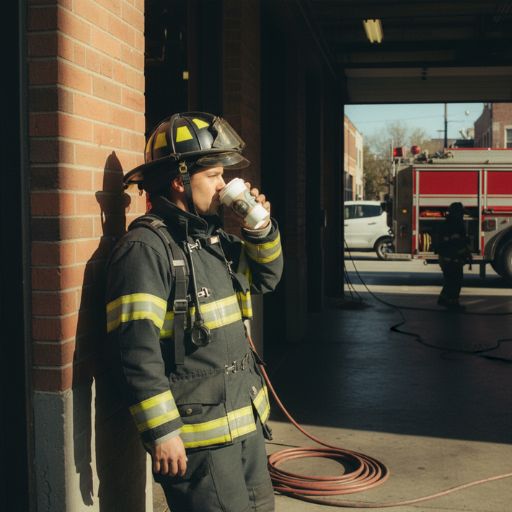
Every morning, without fail, my brother showed up at my coffee shop before his shift. He’d stand at the counter in full gear, smelling of smoke and soap, and joke that the caffeine hit harder than the fires. It became our ritual—me sliding him his cup, him raising it like a toast before heading out.
But that last morning felt different. He lingered longer by the counter, sipping slower, watching the door like he was buying time. I asked if something was wrong. He just smiled, tapped the lid twice, and said, “Save me one for later.”
Hours passed. My shop stayed open, customers came and went, and I kept glancing at the clock, waiting for him to walk back in like always. He didn’t. Instead, one of his fellow firefighters came in, not in uniform but in regular clothes. His face was pale, and he looked at me with the kind of eyes that carried bad news.
I froze. Before he said a word, I knew something had happened. He cleared his throat, struggling with the words. “There was a call. An old warehouse down by the river. It went bad. Your brother… he made it out, but…” He stopped, shaking his head, clearly holding back emotion.
“But what?” I asked, voice breaking before I could hold it steady.
“He saved three people. Pulled them out himself. But he took a hit—burns, smoke, and… something in him just changed. Physically, he’ll recover. But mentally, I don’t know.”
My chest tightened. Relief that he was alive collided with dread for what the man was trying not to say. I closed the shop early and rushed to the hospital.
When I saw him lying there, he looked intact, just wrapped in bandages on his arms, oxygen tubes under his nose. But when his eyes met mine, there was something distant, like he wasn’t fully here anymore. He smiled, faint and hollow. “Guess you’ll be saving that coffee for a while.”
I laughed weakly, though it felt wrong. Something was off.
The days turned into weeks. He came home, but he wasn’t the same brother who teased me at the counter. He stopped showing up at the shop in the mornings. He stopped talking about the fires. Nights, I’d hear him pacing in his apartment upstairs, or sometimes shouting in his sleep. I offered to sit with him, make coffee, talk it out. He always refused, saying, “You wouldn’t get it.”
But the truth was, I wanted to get it. He was my brother.
One evening, months later, I closed the shop early and knocked on his door. He let me in reluctantly, the place a mess of half-eaten meals, unopened mail, and clothes strewn across the couch. He sat down heavily and buried his face in his hands.
“I can’t walk back in there,” he said finally. “Not the firehouse. Not your shop. Not anywhere that reminds me of that day.”
I didn’t know what to say. I’d never seen him like this, stripped of the confidence and strength I’d always known him for. I told him, quietly, “You don’t have to carry it alone. Whatever happened, you’re still you.”
But he shook his head. “No. That version of me died in that warehouse. You got a stranger now.”
For a while, I believed him. I stopped pressing, stopped waiting for him to show up at the shop. Customers asked about him, and I’d say he was busy. Inside, though, I felt like I’d lost him, even though he lived upstairs.
Then one morning, almost a year later, the bell above my shop door jingled, and there he was. He looked thinner, older somehow, but he was holding that same faint smile. He walked up to the counter and said, “Is that coffee still waiting for me?”
I didn’t answer. I just poured it and slid it over. He tapped the lid twice, just like before, and for a brief moment, I saw my brother again.
That morning, after finishing his cup, he surprised me. He said, “Come with me.”
I locked up early, and we walked together to the riverfront where the warehouse once stood. The building had been demolished, replaced by an empty lot with weeds pushing through the concrete. He stood there a long time, quiet, before finally speaking.
“That day, I almost ran. When I heard the beams cracking, when the smoke got too thick, I thought about saving myself. But I didn’t. And ever since, I keep asking myself why. Did I do it because it was right, or because I was too scared of what people would think if I didn’t?”
I let the question sit in the air. Finally, I said, “You saved lives. That’s what matters. The rest… that’s just noise your mind is playing.”
He looked at me, eyes wet, and whispered, “I needed to hear that. From you.”
That was the first step.
Over the next months, he started coming by the shop again. Not every day, but often enough that I saw the light creeping back in. He didn’t put on his uniform again, though. He left the firehouse. Said he couldn’t go back to it without breaking.
Instead, he started helping me at the shop. At first, just washing dishes and wiping tables, but soon he learned how to work the espresso machine. He had big, calloused hands that looked clumsy with the delicate cups, but he found a rhythm. Customers warmed to him quickly. Some even came back just to chat with him.
And here’s the twist I didn’t expect: he was good at it. Better than me, even. He had a way of remembering people’s names, their orders, and even little details about their lives. He made the place feel warmer, more alive.
One afternoon, a customer asked if he owned the shop. He laughed and said, “Not yet.” But later that night, he told me, “Maybe that’s the point. Maybe I was supposed to leave that life behind and find this one.”
I didn’t argue. It felt right.
But not everyone agreed. Some of his old crew came by, urging him to return. They said the department needed men like him. One even accused him of being selfish for quitting. My brother listened politely, then simply said, “I’ve already done my part. Now I need to do this.”
It took courage to stand his ground.
Years later, people still remember him as the firefighter who saved three lives. But I’ll remember him more as the man who stood behind the counter with me, pouring coffee, listening to people, and quietly rebuilding himself one cup at a time.
And here’s the part that still gets me. Remember how he used to tap the lid twice on his coffee before walking out? Well, he taught it to customers. He’d tell them, “Tap it twice for luck, or for whatever you need today.”
Soon, it became a ritual in the shop. People tapped their cups before leaving, smiling, sharing stories. What started as a nervous habit of his became a symbol of resilience, of moving forward no matter what weighed you down.
My brother never went back to who he was before that warehouse fire. He couldn’t. But he found a new version of himself, one that wasn’t defined by loss but by what he chose to build after it.
And I realized something important. We don’t always get back the people we lose, not in the same way. Sometimes they come back changed, scarred, or searching. But if we give them space, patience, and love, they can become someone even stronger.
The last time he and I closed up the shop together, he handed me a cup and said, “You know, you saved me too. Just by waiting.”
That hit harder than any fire ever could.
Life doesn’t always give us the endings we imagine. But sometimes, the twist is better than what we wanted in the first place. My brother thought he’d lost himself in that fire, but in truth, he’d only just begun to find who he really was.
And the message is this: healing doesn’t look like going back. It looks like going forward, even if the path is messy and unexpected. Don’t measure people by who they were, but by the strength it takes for them to keep moving.
If you’ve read this far, I hope it reminds you to be patient—with yourself, and with the people you love. Because sometimes, saving someone isn’t about dragging them out of a burning building. Sometimes it’s about pouring them a cup of coffee and waiting until they’re ready to take the next step.
If this story touched you, share it with someone who might need to hear it today. And don’t forget to like it—it helps spread the reminder that even after the hardest fires, there’s still a chance to rebuild.