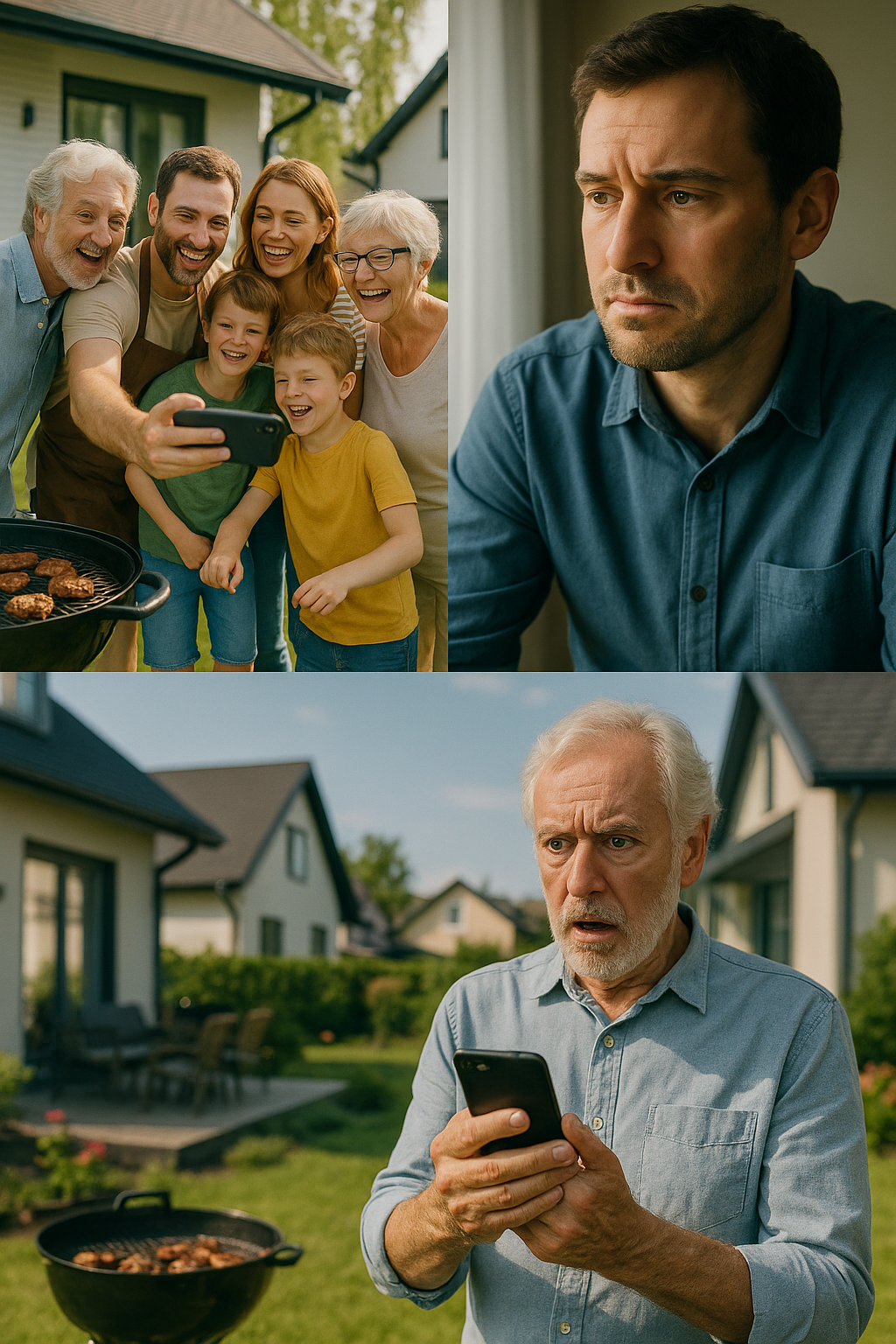
When I collapsed at work, the doctors called my parents. They never came. Instead, my sister tagged me in a photo: ‘Family day without the drama.’ I said nothing. Days later, still weak and hooked up to machines, I saw 74 missed calls—and a text from Dad: ‘We need you. Answer immediately.’
Without hesitation, I turned off my phone.
For weeks, I knew something wasn’t right. Headaches. Dizzy spells. That crushing tightness across my chest. But I brushed it off. I couldn’t afford to stop—not with my family’s endless expectations pressing down on me.
To them, I was the problem-solver. The one who picked up the bills. The one who loaned money without a word. My sisters wrecked cars and got comfort. I earned awards and got silence. So I kept grinding, working through weekends, convincing myself it was fine.
Until Monday morning. I stood up from my desk, and the world disappeared.
The next thing I remember: the sharp beep of monitors. Wires taped to my chest. The doctor’s voice—calm but heavy. Cardiac episode. Lucky your co-workers dialed 911. My parents were called. They were my emergency contacts. I waited. An hour. A day. Nothing.
Then came the Instagram tag—a gut punch. Madison’s smiling face at the lake, plates of fried chicken and pie on the table. The caption: “Family day without the drama.” She’d tagged me. Like I was the joke. Something inside me shut off, cold and final.
Days later, still tethered to machines, my phone buzzed. Seventy-four missed calls. A single message from Dad: “We need you. Answer immediately.”
No apology. No concern. Just demand.
And without thinking twice, I turned the phone off again.
That night, I stared at the hospital ceiling for hours. I replayed every time I bailed them out. Paid Madison’s tuition when she blew her scholarship. Covered Mom’s dental work. Wired Dad money when his “investment” tanked. I was 32, and all I had was a two-bedroom apartment, a burned-out heart, and a family that saw me as a resource, not a person.
I thought about deleting their numbers. I didn’t. But I saved a new contact in my phone: “Boundary Mode: ON.”
When I got discharged, I didn’t go back to work right away. For once, I rested. I sat on my tiny balcony, drank tea, and watched squirrels fight over peanuts. I didn’t answer calls unless they came from my doctor, my therapist, or my best friend, Olivia.
Olivia had been my roommate back in college. She knew the old me—the girl who used to paint, used to laugh. She showed up at the hospital with socks that had tacos on them and a homemade smoothie. She texted every morning: “Still breathing? Good. Hydrate, dummy.”
She was the first person who didn’t ask for anything. Just gave.
Two weeks into my recovery, Madison showed up at my door.
I almost didn’t answer. But curiosity got the better of me.
She looked good, as always—hair curled, lashes perfect, like she was heading to brunch instead of confronting the sister she publicly humiliated. She held up a Starbucks cup like it was a peace offering.
“Thought you might want your favorite,” she said. “Extra cinnamon, no whip.”
I stepped aside. Mostly to avoid a scene on the doorstep.
She talked. I listened. She said the tag was a joke. Said she didn’t think I’d see it. That she didn’t mean it like that. That Dad was freaking out because he might lose the house. That Mom was stressed. That they needed me.
I sipped the coffee.
She waited.
And then I said, “I had a heart attack, Madison. A heart attack. At thirty-two.”
Her smile faded. “They didn’t tell me that.”
“They didn’t come.”
She opened her mouth. Closed it.
“I’m not your safety net anymore,” I added. “Tell Dad I hope he figures it out.”
I walked her to the door. Not angrily. Just… calmly. For the first time in my life, I didn’t feel guilt. I didn’t feel responsible. I felt like someone who’d finally stepped off a stage after years of performing.
And it was quiet.
Weeks passed. I started part-time remote work. Took walks. I found a beginner’s watercolor set online and painted the view from my window. I still got texts—some passive-aggressive, some pleading—but I didn’t respond. Not until I was ready.
The twist came in the most unexpected way.
Olivia and I were having lunch at a park one Sunday when a man walked up. He looked familiar, but older, tired.
“You’re Natalie, right?” he asked.
I nodded, confused.
“I’m Evan’s dad,” he said.
Evan. My college boyfriend. The one who’d broken my heart when he ghosted me senior year. I hadn’t heard his name in over a decade.
“I… don’t understand,” I said.
He looked uncomfortable. “Evan passed away last month. Cancer. It was fast. But before he went, he gave me this.” He handed me a worn envelope. “He said if I ever saw you—and I mean, ever—I had to give it to you.”
I took the envelope with shaking hands.
After he left, I opened it.
Inside was a letter. Written in Evan’s messy scrawl. He apologized. Said he’d been scared back then—of commitment, of not being enough. Said he’d never stopped thinking about me. That he followed my career, saw my articles published, and was proud. That I deserved the world.
And at the end, a line that hit like lightning: “You gave so much to everyone else, Nat. Please promise me you’ll start giving to yourself.”
I cried for a long time.
That night, I lit a candle and wrote back—not to send, but to release.
I told Evan I forgave him. That I was learning to forgive myself. That I’d started painting again. That I’d learned to say no. That I’d finally remembered what it felt like to breathe.
A month later, I posted my first piece of art online.
It was a small watercolor—sunset over a lake. I captioned it: “Family isn’t always blood. Sometimes it’s the people who show up when you can’t even ask.”
It went viral.
Messages poured in. From strangers. From friends I hadn’t heard from in years. People sharing their own family wounds, their burnout, their healing. I wasn’t alone. None of us were.
That’s when I got the idea.
With Olivia’s help, I started a small online community: The Soft Reboot. A space for people like me—burned out, overlooked, but still hopeful. We had virtual paint nights, story-sharing sessions, even “no” practice circles where we rehearsed setting boundaries.
And for the first time, I felt like I belonged.
Six months after the hospital, I got another message from my dad.
This time, it said: “I’m sorry. I didn’t know how to be there for you. I failed. If you ever want to talk, I’m here.”
I didn’t reply right away.
But eventually, I did.
I told him I was healing. That I forgave him, but I needed space. That I was rebuilding, brick by brick. And that I hoped, someday, we could build something healthier.
He didn’t argue. Just replied: “I understand. I’ll be here.”
And you know what? That was enough.
Madison and I didn’t magically become close. But we’re civil now. She’s in therapy. She told me she’s starting to understand how much pressure I carried. She even joined one of the Soft Reboot calls—anonymously, but I knew it was her.
I still paint. I still work, but with better balance. I take walks. I drink tea on my balcony. I laugh with Olivia. I rest.
And every time I start to feel that old tug—the one that says give more, fix it all, be everything to everyone—I read Evan’s letter again.
“Please promise me you’ll start giving to yourself.”
And I do.
I keep that promise.
So if you’re reading this, burned out and tired, always showing up for everyone else—this is your sign. Rest. Step back. Say no. Let yourself matter. Let yourself be.
Because sometimes, healing starts with one moment of clarity.
For me, it was a tagged photo that broke the illusion.
For you, maybe it’s this story.
So share it. Like it. Let someone else know they’re not alone.
Because we all deserve family.
And sometimes, we find it in the most unexpected places.