I had a stroke and was unconscious for two days. When I woke up, I saw my DIL at my bedside, telling me, “You’re in good hands now.” Too weak to ask her, I just listened as she spoke to nurses about nursing homes outside of town.
What I didn’t know was that my son wasn’t in the country anymore. He had left for Dubai two months ago, and nobody had thought to tell me.
I blinked slowly, trying to wrap my head around what was happening. The machines beeped gently beside me, the room smelled like antiseptic, and my limbs felt heavy as bricks. My daughter-in-law, Cami, stood near the window, scrolling on her phone like this was just another Tuesday.
Cami and I were never close. She always kept things polite but distant. I never pushed, hoping time would build a bridge between us. My son, Doru, had changed a lot since marrying her. More business trips, fewer phone calls. Still, I never imagined he’d leave without saying goodbye.
Over the next couple of days, I overheard more than I was supposed to. Cami spoke to a facility called Sunny Grove over the phone, asking if they had a single room available for a long-term stay. She mentioned “budget” and “no family visits for now.” Every word felt like a stone dropping into my chest.
I didn’t say anything. Not because I didn’t want to—but because my voice wouldn’t come out. My stroke had paralyzed part of my face, and I couldn’t lift my right arm. I was trapped in my own body, watching my life get rearranged like furniture in someone else’s house.
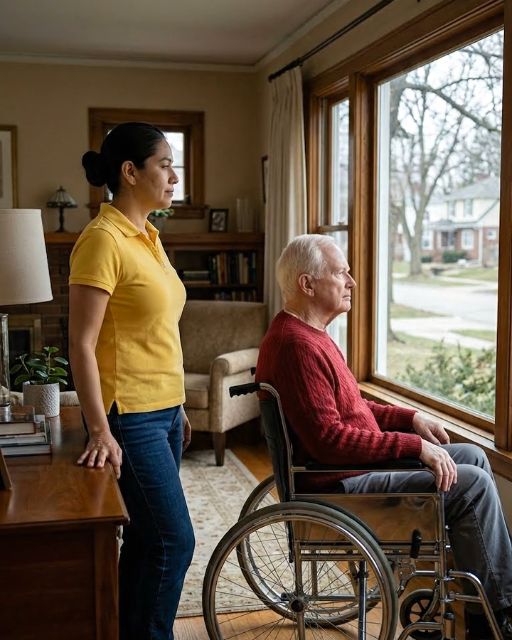
One nurse, a quiet woman with kind eyes named Marta, picked up on my frustration. She’d whisper to me when checking my vitals, brushing my hair gently like I was her own father.
“Don’t worry, tataie,” she said one evening. “I’ll make sure you’re treated well.”
A week passed, and I was discharged to Sunny Grove. It was clean, bright, with walls painted in soft greens and yellows. But it wasn’t home. My books weren’t there. My coffee mug with the faded print from my old job wasn’t there. Neither was the chair where I used to sit every morning watching the sun rise.
They gave me a corner room and a schedule. Breakfast at 8, therapy at 10, lunch at 12, then some activities. At first, I was grateful to just be alive. But by the third week, I realized—no one was coming.
Cami didn’t visit. Doru didn’t call. No video messages, no letters. I was a loose end in their busy lives, tied up neatly and tucked away.
But fate, as it turns out, wasn’t finished with me.
During a group therapy session, I met Ion, a retired mechanic who had lost his wife the previous year. He had the same dry humor I remembered from my factory days. We clicked immediately. He had a daughter who visited every Sunday, bringing him homemade sarmale and magazines about old cars.
“She’ll bring extra next time,” he grinned. “You can try the real stuff again.”
And she did.
Mira, his daughter, was in her early 30s, with curly brown hair and a voice that filled the room. She greeted everyone like family. One Sunday, she sat beside me during lunch and asked how I ended up there.
I didn’t speak much. My words still came out slow, jumbled. But she listened. Patiently. Like my words mattered.
From then on, every Sunday became something to look forward to. Mira would bring food, stories from her job at the local library, even books with big print so I could try to read again. She brought puzzles, photos from trips she took, and once, a postcard from Sibiu because I had mentioned I grew up nearby.
One day, as we sat under a tree in the yard, she said, “It’s strange, isn’t it? How sometimes the people who should show up… don’t. And those you never expected… do.”
That stuck with me.
A month later, something changed. I got a letter.
It wasn’t from Doru. It was from a lawyer.
Apparently, my house—my home of 42 years—had been sold. The paperwork was signed by my son using power of attorney I’d given him years ago after he promised to handle my bills if I ever got sick. I never imagined he’d use it to sell the only place that still felt like mine.
I stared at the letter until the words blurred.
That night, I cried for the first time since the stroke.
But the next morning, I asked to speak to the director of Sunny Grove. With Marta’s help, I told him I wanted access to a phone. I needed to make a call—to a cousin, someone, anyone. He nodded, understanding. He’d seen this before, I think. People being shuffled off like furniture.
That call led me to Vasile, my late sister’s son. We hadn’t spoken in years, but when he picked up, he cried. He hadn’t known I was in a home. He thought I was still in my house, tending the little garden in the back.
Three days later, he drove four hours to visit me. He brought photos of his kids, warm placinte from his wife, and a promise.
“You’re not staying here, unchiule. We’ll figure this out.”
He wasn’t rich. He lived in a modest apartment in Craiova, worked long hours in a print shop. But he had heart. And sometimes, heart is all you need.
Over the next few weeks, Vasile helped me meet with a pro bono lawyer. Turns out, the sale of my house wasn’t as legal as Doru thought. The lawyer uncovered a few irregularities—Cami had forged some consent forms. With that, we had a case.
The legal process was slow, and I was still in Sunny Grove. But I felt something I hadn’t in months—hope.
Mira continued to visit. Vasile came whenever he could. Even the staff at the home started treating me differently. I wasn’t just a file number anymore. I was someone with people who cared.
Six months later, the court ruled in my favor. The sale was reversed. The house couldn’t be returned to its original condition—it had been emptied—but it was mine again. The judge called it “a breach of ethical trust.” Cami and Doru didn’t even show up in court.
I didn’t cry this time. I smiled.
I moved back into my house with help. Vasile and his boys painted the walls. Mira found furniture at second-hand shops and made the place feel like home again. Marta, the nurse from the hospital, even visited one afternoon with a pot of soup and a hug.
Rebuilding wasn’t easy. My body was slow. My speech came in bursts. But my heart? My heart was full.
Three months after I moved back, something unexpected happened.
I got a letter from Doru.
It was short. No apology. Just a paragraph explaining how “life got complicated” and “he did what he thought was best.” He said he and Cami had separated. That he was still abroad. That maybe one day, we could talk.
I folded the letter and placed it in a drawer.
Maybe one day, we will. But not today.
Today, I have Mira, who still visits and calls me “Bunicu.” I have Vasile, who makes me laugh like my sister used to. I have Marta, who calls every few weeks to check in. And I have my home, filled with quiet mornings and the sound of the kettle whistling just right.
There’s an old Romanian saying: “Cine nu are bătrâni, să-și cumpere.” Meaning—those without elders should find one. We carry stories. Lessons. Wounds and wisdom.
I lost a son to distance and ambition, but I gained a whole new family in the cracks he left behind.
Sometimes, what breaks you also makes space for what truly belongs.
If you’re reading this and you feel forgotten, please know—life isn’t done surprising you. Sometimes, help comes from places you’d never expect. Sometimes, strangers become your greatest gifts. And sometimes, justice shows up late—but shows up still.
So don’t give up.
Share this story if it reminded you of someone. Like it if it made you feel something. And reach out to that older neighbor, uncle, or friend you haven’t spoken to in a while.
You never know whose life you might change. Or who might change yours.