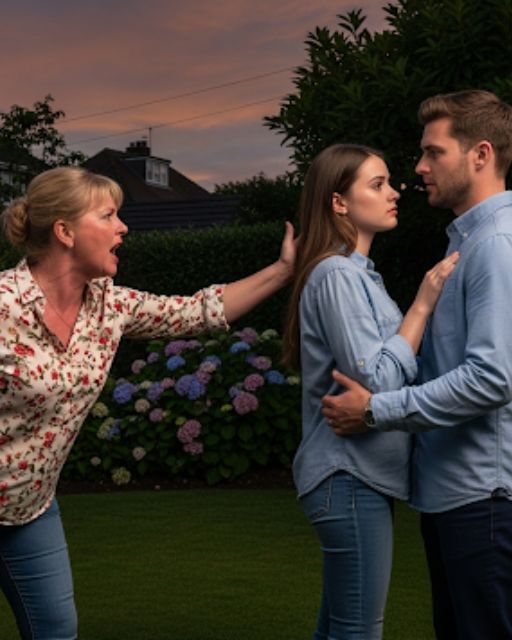
My husband and I spent months building our dream garden. The next-door neighbor, a woman we’d only ever seen yell at delivery drivers, marched over and declared it was her property. She even called the police. As the officer listened, she pointed to a photo on her phone, then to the garden. That’s when my husband gasped. The photo showed the exact same plot of land—our garden—except in her picture, there was no fence, no boundary markers, just open grass that seemed to flow into her yard.
The officer raised his eyebrows and asked us calmly if we had any documentation to prove where the property line was. My stomach dropped. We had never even thought about that. When we bought the house, the agent mentioned the fence, and we assumed it was the border. Why would we question it?
My husband ran inside and came back with a thick folder. Deeds, contracts, all sorts of papers. He laid them on the hood of the police car while the officer flipped through them. The neighbor smirked the whole time, standing with her arms crossed, her phone clutched in her hand like it was the smoking gun.
Then the officer paused. He leaned closer, reading something carefully. “It looks like the original survey markers are… actually a few feet off from where this fence was built,” he said slowly. My heart thudded in my chest. “Technically, this garden is not entirely on your property.”
The neighbor’s smirk widened into a grin. “See? I told you. They stole my land.”
I wanted to argue, to scream, but the officer held up a hand. “It’s not that simple. The fence has been here for years, and property disputes like this usually go through civil court. It’s not a police matter. I’m just here to keep the peace.” He packed up his papers and looked at both of us. “I’d recommend getting a land survey done and talking to a lawyer if you want to contest it.”
And just like that, he drove off. My husband stood frozen, staring at the neighbor. She looked delighted. “You’ll be hearing from me,” she said coldly, before turning back toward her house.
That night, we barely spoke. We had worked so hard on that garden. Every weekend, every evening after work, our hands in the soil. We planted roses, tulips, and a small vegetable patch. My husband had even built a wooden bench with his father’s old tools. And now it might all be taken away because of a line on a piece of paper.
The next morning, we decided to fight it. We hired a surveyor, who came with his equipment and marked out the exact borders. Sure enough, three-fourths of the garden sat on our property, but the last quarter—the part with the roses—was technically on the neighbor’s side.
I wanted to cry. My husband just stood there, fists clenched. The surveyor shook his head sympathetically. “This happens more often than you’d think,” he said. “But there’s something called ‘adverse possession.’ If the fence has been up long enough, you might have rights to that land.”
So we called a lawyer. She explained that if the fence had been there for over twelve years, unchallenged, we could claim the disputed section as ours. That gave us hope. We started digging into the history of the house, even asking the elderly couple down the street if they remembered when the fence was built.
Meanwhile, the neighbor didn’t waste a second. She started showing up outside, taking photos of us every time we stepped into the garden. Once, I caught her measuring the space with a tape measure while muttering under her breath. It was exhausting, living next to her.
A week later, a letter arrived. She was suing us, demanding the removal of the fence and full access to the “stolen” part of her yard. I felt sick reading it.
But then something unexpected happened. While gathering documents, my husband stumbled across a stack of old photographs from the previous owners. In one of them, dated fifteen years ago, the fence was already there. The garden space looked almost exactly as it did now, minus the flowers. That was enough proof to strengthen our case.
We went to court, terrified. The neighbor strutted in like she had already won, her lawyer carrying a pile of folders. When it was our turn, our lawyer calmly presented the photos, the survey, and even a testimony from the couple down the street who swore the fence had been there since they moved in—twenty years ago.
The judge leaned back, fingers steepled. After a long pause, he ruled that the land was indeed ours through adverse possession. Our garden was safe. I wanted to cheer, but I just held my husband’s hand tightly and exhaled the breath I’d been holding for months.
The neighbor’s face twisted in fury. She stormed out without even looking at us. We thought that was the end of it.
But it wasn’t.
Over the next few weeks, small things started happening. Our mailbox was knocked over. Trash appeared in our yard. One morning, I found our rose bushes hacked down with garden shears. I knew who had done it, but we had no proof. My husband wanted to set up cameras, but I hesitated. Part of me wondered if this was karma testing us, asking how far we were willing to go.
Then, one night, there was a knock on our door. It was the same neighbor, but she looked different. No smirk, no anger—just exhaustion. Her eyes were red, like she’d been crying.
“I need to talk to you,” she said softly.
I glanced at my husband, and we let her in. She sat at our kitchen table, wringing her hands. After a long silence, she confessed.
Her husband had died two years ago, right before we moved in. He had planted roses on that patch of land, and she always considered it part of her yard because they had tended it together. When we built our garden there, it felt like we were erasing him.
She admitted she knew about the fence and the property lines. She knew she had no legal case. But anger had consumed her, and suing us felt like the only way to fight back against the loneliness.
I didn’t know what to say. For months she had made our lives miserable, and now she sat crying in our kitchen, telling us the very roses she had cut down were tied to her grief.
My husband finally spoke. “Why didn’t you just tell us?”
She shrugged, tears rolling down her face. “I don’t know. I was angry at the world, and you were just… there.”
Something shifted in me that night. For the first time, I saw her not as a monster, but as a human being who was hurting.
We made a choice. We told her she could share the garden. Not legally—on paper, it was ours—but in practice, she could come tend the roses, sit on the bench, or just spend time there whenever she wanted.
At first, she resisted, suspicious of our offer. But slowly, she began to show up. She brought new rose cuttings, planting them alongside the ones that had survived. She even started talking to us, little by little.
It wasn’t easy. Trust didn’t come overnight. Sometimes she still snapped at delivery drivers or muttered under her breath. But other times, she would bring over a basket of vegetables she’d grown, or she’d sit with us on the bench and tell stories about her late husband.
The garden changed, too. It wasn’t just ours anymore—it became something shared. A strange truce grew between us, rooted in the very soil we had once fought over.
And here’s the twist I didn’t expect: opening that space to her didn’t diminish it for us. It made it richer. We learned that sometimes winning isn’t about keeping everything to yourself, but about knowing when to let go and allow others in.
Months later, I looked out the window and saw her kneeling by the roses, smiling faintly as she brushed dirt from her hands. For the first time, she looked at peace. And in that moment, so did I.
The garden we fought for became the garden that healed us all.
If there’s one lesson I took from this, it’s that property lines and fences don’t define who we are. Compassion does. Sometimes the people who seem the hardest to love are the ones who need it most.
So if you’ve got a neighbor, a coworker, or even a family member who feels impossible to deal with, remember—behind their anger might be pain you can’t see. And kindness, even when it feels undeserved, can change everything.
Thank you for reading this story. If it moved you, please share it with someone who needs a reminder that forgiveness and compassion can turn enemies into neighbors, and neighbors into friends. And don’t forget to like this post so more people can see it.