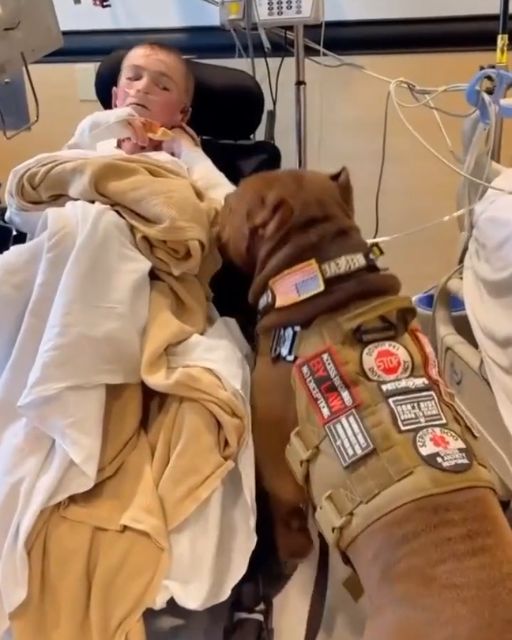
He hadn’t spoken in four days—just stared past us, hooked up to beeping machines, barely blinking. Then the therapy dog came in. Big, quiet, wrapped in patches and purpose.
The boy’s fingers TWITCHED. He slowly reached out, touched the dog’s head, and whispered something none of us expected. The nurse leaned in and gasped, “He just said ‘Ranger.’”
I turned to her, stunned. Ranger wasn’t a name we’d ever mentioned around him, not at the hospital. Not once in the four days since the accident.
That was the name of his old German Shepherd. The one he used to run around the backyard with, tie red bandanas around his neck like he was in a cartoon, and sleep beside when the nightmares got bad. Ranger had passed away the year before.
I looked at my son. For the first time in days, he had tears in his eyes. Real, full tears—not from pain, but something deeper. The kind that let you know a wall had cracked somewhere inside, and light was starting to leak through.
“Did he really say that?” I whispered.
The nurse nodded. “Clear as day.”
I knelt beside the bed and gently took my son’s hand. “You remember Ranger, buddy?”
His eyes flickered toward me. Then a small nod. Weak, but sure.
The therapy dog, a golden retriever named Maisie, sat still, like she knew her job wasn’t done. She rested her chin on the side of the bed, eyes locked on my son like she was waiting for a cue only he could give.
That was the first real moment of hope we’d had.
Just four days earlier, we were a regular family. I was making pancakes in the kitchen, humming some forgotten tune. My husband, Mark, was trying to untangle Christmas lights in the garage even though it was April. And our son, Caleb, had convinced his friend to build a treehouse in the old oak near the edge of our property.
No one expects a branch to snap. No one expects to hear screaming like that—a gut-wrenching sound that slices through you before your brain even knows what’s going on.
By the time we got there, he was unconscious. His friend had sprinted home for help. We called 911, but those minutes before the sirens came were the longest of my life.
They rushed him into surgery. He had a traumatic brain injury, a fractured pelvis, and a dislocated shoulder. But it was the silence afterward that scared us most.
He wouldn’t wake up at first. Then he woke up and wouldn’t speak. Wouldn’t look at us. Just stared straight ahead like he was stuck between two places and couldn’t decide where to land.
Doctors said it could be trauma. Or swelling. Or both. They couldn’t say when—or even if—he’d come back.
So we waited.
Talked to him. Played his favorite music. Read his old Captain Spectre comics. But nothing worked.
Until Maisie.
She was part of a local therapy program run by a woman named Trina. I hadn’t even known it existed until one of the nurses mentioned it quietly, like she didn’t want to get our hopes up.
Trina brought Maisie in once a week to visit the pediatric wing, usually stopping by the playroom or the kids getting chemo. She wasn’t scheduled to visit ICU that day. But something told her to stop in anyway.
“I had a feeling,” she said later. “Didn’t know why. Just felt pulled.”
I don’t pretend to understand those kinds of things. But when Caleb whispered Ranger’s name, I didn’t need to.
The next day, Caleb whispered again. “Not him.”
At first, I didn’t know what he meant. Then he pointed—slowly, shakily—toward the corner of the room.
There was nothing there.
Just a chair. A coat rack.
But I knew my son wasn’t making things up. Something was shifting in him.
Over the next week, his words came in slow trickles. Short sentences. Mostly about Ranger. “He barked last night.” Or “He was in the treehouse.”
I worried. I thought maybe his mind was confused—mixing past and present. But when I brought it up with the pediatric psychiatrist, she didn’t seem alarmed.
“Sometimes, familiar anchors are how the brain finds its way back,” she said. “Ranger might be his anchor.”
That night, I went home and pulled out a framed photo of Caleb and Ranger from the year before. They were both muddy, standing by a pile of leaves they’d jumped into over and over. I brought it back the next morning and placed it by his bed.
He stared at it for a long time.
Then he whispered, “He caught me.”
I blinked. “What, sweetie?”
“He was there. When I fell. He caught me.”
It made no sense. But there was something in the way he said it—a softness, like he truly believed it.
I hugged him gently. “Maybe he did.”
Caleb’s recovery was slow. He had to relearn how to move his left leg, regain speech fluency, and get through the nightmares that came most nights.
But he started smiling again.
He even laughed—really laughed—when Maisie returned two weeks later wearing bunny ears someone from the children’s wing had made for her.
I’ll never forget the first time he said, “Can she come home with us?”
Trina smiled kindly. “She’s got a lot of patients to visit. But I think she’ll always remember you.”
Caleb looked down, disappointed. So we made him a deal.
If he could walk by summer, we’d talk to Trina about a therapy dog of his own.
The physical therapist thought we were being overly optimistic.
He was walking—albeit slowly—by mid-June.
Trina didn’t have a Maisie twin, but she introduced us to a rescue program that paired dogs with kids recovering from trauma. That’s how we met Banjo.
A six-year-old lab mix who had been found tied to a fence, ribs showing, eyes wary. But the second he met Caleb, he sat right beside his wheelchair and placed a paw on his knee like he’d been waiting for this boy his whole life.
They became inseparable.
Banjo slept beside Caleb every night. Sat through therapy sessions, licked away tears, and once even carried a small toy in his mouth just to make Caleb laugh.
Then came the twist none of us saw coming.
That fall, I received a letter in the mail. Handwritten. No return address.
Inside was a photo—of Caleb and Banjo playing in the backyard. I hadn’t taken it. Mark hadn’t either.
There was just a note:
“He’s got another guardian now. But Ranger’s still watching. Thank you for believing.”
No signature. Nothing else.
I turned the envelope over. The postmark said the next town over. But we didn’t know anyone there.
I asked around. No one had been by our house. We didn’t have security cameras—just a motion light by the back porch. It hadn’t gone off that night.
I don’t know who sent it. I probably never will.
But I stopped needing answers.
Somehow, I believe Ranger was there that day. In whatever way he could be.
I believe that something in Caleb reached for him when everything else went dark.
And Ranger came back—not in fur and paw, but in memory, in feeling, in some invisible thread that led a therapy dog named Maisie to our door.
We never stopped calling her “the one who cracked the ice.”
And Banjo?
Well, Banjo stayed. For good.
Caleb’s doing well now. He still walks with a slight limp and gets headaches if he plays too hard. But he’s back in school. Back to building things out of cardboard and glue. Back to wearing mismatched socks because “it keeps people guessing.”
He and Banjo won second place in a local dog show for “Best Trick.” The trick? Banjo sits, then lies down, and Caleb lies beside him with a hand over his heart.
That’s it.
But the crowd always goes silent.
Because they see what we see.
A boy who found his way back.
A dog who chose to stay.
And something else—something quieter—that fills the space between them.
I don’t know if you believe in things like guardian spirits, or the unspoken ways love travels across time.
But I do now.
And I’ve learned that healing doesn’t always come the way you expect. Sometimes it arrives in fur. Or in a whisper. Or in a letter with no name.
Whatever form it takes, if it brings someone back to themselves… that’s enough.
So here’s what I’ll say:
If you’re waiting for a sign, for something to crack the silence around someone you love—don’t stop believing. Keep reading to them. Keep showing up. Keep talking, even when they can’t talk back yet.
Because sometimes, it only takes one moment, one memory, or one soft paw to bring the light back in.
Thanks for reading our story. If it touched you, share it with someone who might need a little hope today. And don’t forget to like the post—it helps us keep spreading stories that matter.