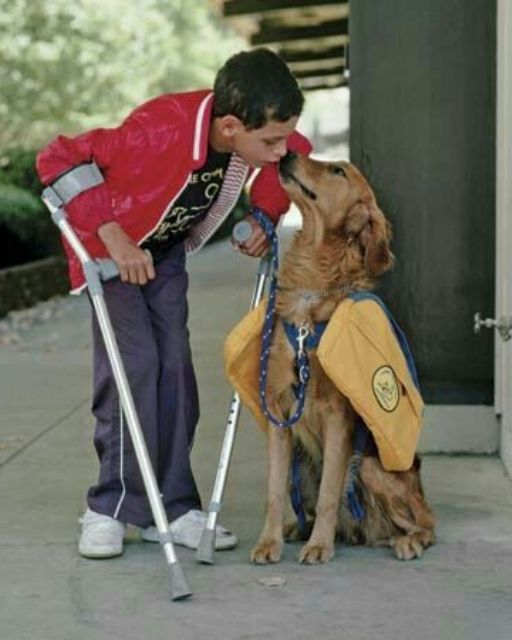
He was more than a service dog—he was my best friend, my shadow, my steady legs on hard days. Every morning he’d nudge my crutches toward me, tail wagging, ready for school. But today, as we reached the front steps, he WHINED and wouldn’t move. I leaned down to check his paws—and that’s when I saw the blood.
It wasn’t his.
There was a trail of it, just faint, barely dried, leading off the porch and around the side of the house. My dog, Murphy, sniffed the air again, low growl building in his throat, and I froze. We lived in a quiet cul-de-sac in suburban Pennsylvania. The worst thing to happen here was the occasional raccoon tipping over trash cans. But this felt… off.
I hesitated, unsure if I should go inside or turn around. Murphy nudged me with his snout, insistent now, guiding me toward the side yard. I gripped my crutches, followed the trail slowly, heart pounding harder with each step. Just behind the recycling bin, half-concealed under an old tarp, was something—or someone.
It was a man.
Mid-thirties, maybe older, wearing a hoodie, jeans torn at the knee. He was slumped awkwardly, arm pressed to his side where blood soaked through. At first, I thought he was dead—but then he groaned.
Murphy stood guard, alert but not barking, as if he knew this man wasn’t a threat. I reached for my phone with trembling hands and called 911.
While we waited, I asked the man his name. He whispered something like “Rob” and then winced hard, like even talking hurt. I offered him my jacket, though I had little else to give. He just nodded and mumbled, “Thank you,” before passing out again.
The paramedics arrived in under ten minutes, lights flashing silently. They worked fast, lifting him onto a stretcher, asking me questions I barely knew how to answer. No, I didn’t know him. No, I hadn’t heard anything last night. No, nothing seemed stolen. They told me he’d lost a lot of blood and was lucky Murphy had found him when he did.
It wasn’t until the officers arrived that we got a clearer picture.
Apparently, there had been a robbery in a nearby neighborhood. The suspect was shot by a homeowner and fled. They weren’t sure if this man was that suspect—or someone else entirely. But he matched a general description, and the timing added up.
That night, I couldn’t sleep.
I kept thinking about his face, the way he looked at me—not like a criminal, more like someone who had run out of places to hide. And Murphy… he had known. He had sensed something was wrong long before I did. He’d saved that man’s life.
The next morning, two detectives came by the house. One was young and polite. The other, older, had that skeptical look like he didn’t trust anything he didn’t see with his own eyes.
“We’ll need to take your dog down to the station,” the older one said.
I blinked. “Excuse me?”
“It’s standard. He came in contact with a crime scene. We need to check for residue, see if he led the suspect here on purpose.”
Murphy whimpered at my feet. I could barely believe what I was hearing.
The younger detective stepped in. “We’ll bring him back by the evening. It’s just protocol.”
My mom argued a bit, but they insisted. They clipped a leash on Murphy and walked him out the door like he wasn’t my legs, my protector, my best friend. I stood by the window for an hour after they left, praying they’d bring him back safe.
They did—eventually. But Murphy wasn’t the same that night.
He lay by my bed but wouldn’t meet my eyes. Something in him had dimmed. I rubbed his head, whispered how proud I was of him. It took two days before he started wagging his tail again.
Meanwhile, the man—Rob—was still in the hospital. The police confirmed he was the same man who’d broken into the Fergusons’ house two streets over. But it turned out there was more to the story.
Rob had once lived in our town. Ten years ago, he’d been a local mechanic, married, with a daughter. After his wife died in a car crash, he’d spiraled. Lost his job, his home, everything. He’d left town, tried to start over, failed, and somehow ended up back here—broke, desperate, and hiding in the shadows.
The Fergusons’ house wasn’t just a random target. It had belonged to Rob’s late brother. He thought the house was still empty and hoped to find some money or something valuable to pawn. He hadn’t known a new family had moved in. When Mr. Ferguson shot him, it was pure panic that drove him to flee.
Hearing all this didn’t make what he did right.
But it did make it human.
I kept thinking—what if Murphy hadn’t stopped me that morning? What if I’d walked right past him? He would’ve bled out under that tarp alone.
A few weeks later, I got a letter. It was from Rob.
He wrote that he didn’t expect forgiveness. But he thanked me for calling help. Said Murphy saved his life and that he’d been clean for six months before that night. He’d just hit rock bottom after losing his job. He ended the letter with a line I’ll never forget:
“I didn’t want to die that day. Your dog knew that before I did.”
I cried when I read it.
A few months passed. Murphy and I got back into our routine—school, the park, late-night snack raids. But things were never quite the same in the neighborhood. Some people looked at me different. A few whispered about how my dog had “helped a criminal.”
But others saw it for what it was—a second chance. Not just for Rob. For all of us.
One afternoon, we were walking past the local bakery when the owner, Ms. Kelly, waved us inside. She gave Murphy a biscuit and handed me a flyer.
It was for a new community outreach program. “Second Step,” it was called. They were collecting clothes, supplies, and mentorship for people reentering society after prison.
And guess who helped set it up?
Rob.
He’d been sentenced to time served plus probation, thanks to the circumstances and his cooperation. He’d gotten a job with a landscaping company and was trying to rebuild what he lost. Slowly. Quietly.
He didn’t come around often, and when he did, he didn’t expect warm welcomes. But people started noticing. He showed up early, worked hard, didn’t complain.
One day, while volunteering with “Second Step,” I saw him. We made eye contact for maybe two seconds. He gave me a small nod.
Murphy wagged his tail.
That was enough.
Time passed. I finished high school, started community college. Murphy grew older, a little slower, but just as loyal. He’d nudge my crutches the same way, bark at the mailman, sneak bites of peanut butter from my sandwich when he thought I wasn’t looking.
Then, one spring morning, he didn’t get up.
I sat on the floor beside him for hours, stroking his fur, whispering stories, thanking him for every single day.
He passed with his head on my lap.
I buried him under the old maple tree in our backyard, where he used to chase squirrels in his younger days. The whole neighborhood came. Even Rob.
He stood off to the side, hat low, eyes wet. After the service, he approached me.
“Murphy didn’t just save my life,” he said. “He changed it.”
I nodded. “Mine too.”
Rob now works full-time at the animal shelter. He helps train service dogs for veterans and kids with disabilities. He said he never forgot the bond he saw between Murphy and me. Said he wanted to help create that kind of connection for others.
People can change. I’ve seen it with my own eyes.
Murphy taught me that loyalty isn’t about perfection. It’s about being there—especially when things are hard. He didn’t judge Rob. He didn’t hesitate. He just knew someone needed help.
And sometimes, the world needs more of that.
So if you ever find yourself doubting whether one good act can make a difference—remember my dog. Remember how he stopped me at the steps, refused to move, and set into motion a chain of events that saved a life, and maybe even more.
Murphy may be gone now, but his legacy lives on. In every dog trained by Rob. In every person helped by “Second Step.” In every choice we make to see the human behind the mistake.
So tell me… have you ever met a dog who changed your life?
If this story moved you, share it with someone who needs a little faith in second chances. And don’t forget to like—Murphy would’ve wagged his tail for that.