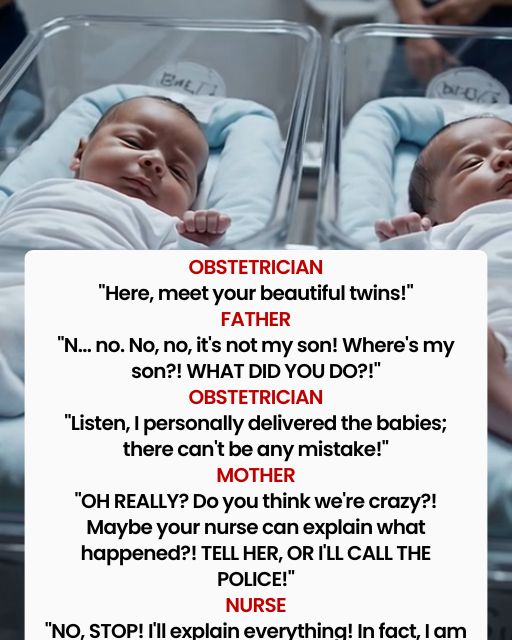
OBSTETRICIAN: ‘Here, meet your beautiful twins!’
FATHER: ‘N… no. No, no, it’s not my son! Where’s my son?! WHAT DID YOU DO?!’
OBSTETRICIAN: ‘Listen, I personally delivered the babies; there can’t be any mistake!’
MOTHER: ‘OH REALLY? Do you think we’re crazy?! Maybe your nurse can explain what happened?! TELL HER, OR I’LL CALL THE POLICE!’
NURSE: ‘NO, STOP! I’ll explain everything! In fact, I am his mother. I mean—his biological mother.
For a second, there was only the buzz of fluorescent lights and the distant wail of another newborn. Then everything went silent. Not a peaceful silence—but one filled with confusion, tension, disbelief.
“You what?” the father asked, voice trembling with a mix of rage and panic.
The nurse, whose badge read M. Harrison, took a shaky breath. “I gave birth to your son two years ago. In this very hospital. He was taken from me. And now… I believe one of these babies is mine.”
The mother gasped, stepping protectively in front of the bassinets. “What kind of sick joke is this?!”
The obstetrician, a veteran of over 1,000 births, turned pale. “Margaret, what are you talking about? We all worked that shift two years ago. You said the adoption was voluntary.”
Margaret looked away. “It wasn’t.”
They moved the babies to the side room while hospital security arrived. The twins—both girls—were sleeping peacefully, unaware that their first hours of life were now tangled in a twisted web of confusion and betrayal.
The father, Marcus, demanded a DNA test. So did his wife, Clarissa. The hospital tried to keep everything quiet, but word spreads fast, especially when it involves newborns and a dramatic outburst in the maternity wing.
Margaret Harrison was placed on administrative leave. She didn’t resist. In fact, she seemed relieved. Almost as if she’d been carrying something heavy for a long time—and had finally dropped it.
What nobody expected was what came out next.
Two years ago, Margaret had delivered a baby boy at St. Luke’s after going into premature labor. She was single, struggling, and in no position to raise a child. The paperwork for adoption had been pushed in front of her almost immediately, with barely any explanation.
“They told me he’d go to a good family,” Margaret whispered during the internal investigation. “They said I could never give him what he deserved. I was still hooked on pain meds after the cesarean. I signed things I didn’t understand.”
But what raised eyebrows was this: when she tried to find out who adopted him, there was no trace of her son’s file. No name, no address. It was like he never existed.
Except Margaret remembered his face. She claimed she’d seen that same face yesterday, just for a second, when Marcus had walked into the hospital with a toddler in his arms, saying he was here to see the birth of his daughters. The boy had the same dimpled chin, the same almond-shaped eyes. She knew. She just knew.
Clarissa denied it at first. “We adopted Jack from a licensed agency in Kansas. We didn’t steal him!”
But when asked to show the adoption paperwork, something odd surfaced. The agency name didn’t check out. There was no record of Children’s Heart Connections Inc.—at least not as a licensed adoption agency. In fact, the building listed on their official papers had been abandoned for over five years.
Marcus didn’t know what to think. “We wanted a baby so badly. We were on waiting lists for years. Then suddenly, a woman contacted us, said there was a newborn available if we acted quickly. It seemed too good to be true—but we didn’t ask too many questions. We were just desperate.”
Clarissa nodded, eyes brimming with tears. “We never wanted to hurt anyone. We thought… we thought we were giving a child a better life.”
The hospital launched an investigation. So did the police. And gradually, more names surfaced—families who had adopted through the same mysterious channel, nurses who had “assisted” with private adoptions, and records that had been subtly altered.
It turned out that Margaret’s son had been taken illegally. And the woman who had arranged the adoption was not an agency rep, but a third-party “facilitator” who worked with someone inside the hospital.
Clarissa’s labor wasn’t fake. She had truly carried the twins. But what made the moment so explosive was the emotional shock of learning that the boy they had raised as their son might not legally—or ethically—belong to them.
The story broke in the local press. Reporters camped outside the hospital. Protesters lined the sidewalk, some holding signs that said “Protect Mothers, Not Black Markets.”
Marcus didn’t care about the cameras. All he wanted was clarity. He had grown to love Jack like his own son. But now he felt like he had been part of someone else’s trauma.
The DNA test came back a week later.
Margaret was Jack’s biological mother.
But what surprised everyone was the next set of results. One of the newborn twins—was also Margaret’s.
A second gasp spread through the hospital boardroom where the results were revealed.
Clarissa blinked. “That’s impossible. I carried both. I felt them kick.”
Doctors were baffled too. But it wasn’t until a senior embryologist stepped in that a theory emerged: embryo mix-up. During IVF.
The twins had been conceived through in vitro fertilization using Marcus’s sperm and a donor egg. But in a bizarre twist of fate, it appeared that one of the embryos implanted in Clarissa had not come from the donor at all—but from a mistakenly fertilized egg retrieved from Margaret, who had gone through a fertility procedure at the same clinic five days earlier.
It was the kind of thing that was almost unheard of. But it had happened. Somewhere between the labs and the clinic, a mix-up had led to Clarissa carrying both a donor child and Margaret’s biological daughter at the same time.
There were lawsuits. So many lawsuits. Against the clinic, the hospital, even the third-party facilitator who had since disappeared.
But through the chaos, something unexpected happened.
Margaret and Clarissa began to talk.
At first, it was tense. Then awkward. Then human.
Margaret had been grieving alone for two years. Clarissa had been living in fear that her dream of motherhood would be ripped from her fingers. Both women, in different ways, had been broken by a system that played with people’s most sacred emotions like puzzle pieces.
They met at a quiet coffee shop, without lawyers or hospital reps.
Margaret had a simple request. “I want to know him. That’s all.”
Clarissa didn’t hesitate. “Let’s figure this out. Together.”
Six months later, they had a custody agreement in place—not just legal, but emotional.
Jack now spends weekends with Margaret, who has moved into a more stable place and started working as a patient advocate for mothers in crisis. He calls both women “Mom,” without confusion. Because kids, sometimes, understand things better than adults.
And the twin girls?
The one who shares Margaret’s DNA is named Hope. The other, still a miracle to Clarissa, is named Faith.
Margaret didn’t fight for full custody. She said she wanted her daughter to grow up loved, safe, and with a big sister.
Marcus, who had been caught in the middle, stepped up. “It’s not about blood,” he said during the final court hearing. “It’s about what we do with the time we’re given.”
The court allowed a unique co-parenting arrangement. Not because it was standard—but because everyone involved agreed it was the most human solution.
People from the outside whispered judgments. Some called it messy. Others called it insane.
But inside that small community, something gentle was growing. A new kind of family. One built on shared heartbreak, resilience, and the decision to do what was right instead of what was easy.
The nurse who had started it all didn’t go back to working the floor. Instead, she began speaking at medical ethics conferences, sharing her story so that future nurses would understand the true weight of trust.
As for Clarissa, she started volunteering with new mothers—especially those going through adoption or fertility treatments. She said, “If I can help one woman avoid what we went through, it’s worth it.”
And Margaret? She never stopped calling herself a mother. But now, when she said it, there was no more shame. No more fear. Just quiet pride.
Sometimes life gives you everything you wanted—but in ways you never expected.
And sometimes, the greatest love stories are the ones born from truth, no matter how complicated.
What would you do if everything you believed about your family was suddenly challenged? Would you hold on—or would you learn to share the love?
If this story moved you, share it with someone who believes in second chances. And don’t forget to like—it helps more people see stories that matter.