I swear he knew.
Beau hadn’t been to the house in nearly six years. After Mama fell and went into assisted care, we leased out the barn, sold the goats, and rehomed every animal but him. Beau was different. He was her baby—she bottle-fed him when his mare rejected him, braided his mane with flowers every spring, whispered to him about her childhood in Andalusia. He’d nuzzle her pockets for sugar cubes, then follow her like a dog.
When hospice called last week, they said she likely wouldn’t last the weekend. Comatose. Lungs shallow. No more IVs. Just us and the beeping machine. I sat by her side, useless, reading Psalms she couldn’t hear.
On Saturday morning, I heard hooves on gravel. Thought it was my cousin’s truck, but no—there was Beau. Standing in front of the house like he knew. The tenant swore up and down he didn’t open the gate. But Beau had walked the full half-mile from the pasture. Alone.
I took him around back, near her window. She hadn’t moved in days.
But when Beau stepped close—just close enough for his breath to fog the glass—her fingers twitched.
I ran inside, thinking I imagined it. But no. One hand, rising slowly. Reaching toward the pane like she was trying to touch something only she could see.
I grabbed her hand and said, “Mama, he’s here. Beau’s here.”
Her eyelids didn’t open, but her lips moved, barely. Just enough to form one word: “Beau.”
I started crying. Not the kind with noise. The kind that sneaks up quiet and burns behind your eyes like smoke. I pressed her hand to my cheek, then to the window, so she could feel the glass where he stood.
Beau let out this soft little nicker, like he was greeting her. Not loud. Gentle. Patient. Waiting.
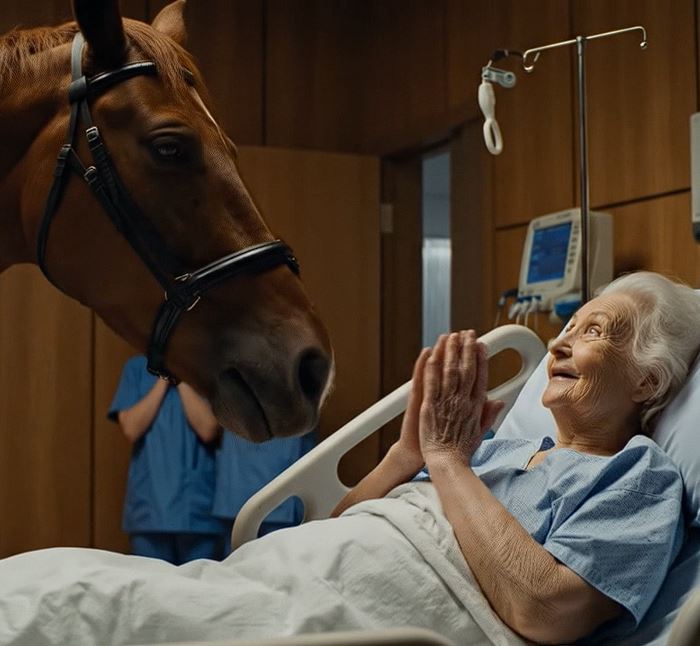
I don’t know what possessed me next. I ran to open the sliding door. The nurses weren’t thrilled, but they didn’t stop me either. I brought Beau right up to the edge of the carpeted room. He didn’t try to bolt or stomp or sniff around. He just stood there, like he understood this was sacred ground.
And then—this part still gives me chills—Mama smiled. Her first expression in five days. A smile.
Her hand twitched again. I guided it to Beau’s nose, and he lowered his head so carefully, like he didn’t want to hurt her. His soft nostrils brushed her palm, and she whispered again. Just a breath: “Good boy.”
Beau stood still as stone after that. For over an hour. Just watching her, blinking slowly, like he was saying goodbye. The nurse on shift started crying too. We all stood there in silence.
She passed later that night.
But it wasn’t sad, not really. Not in the way I feared. It felt… complete. Like she’d been waiting for something. Someone. And once she got it, she could let go.
That should’ve been the end of it, right?
But then came the will.
My sister Adira and I expected the usual: some jewelry, a bit of savings, the house we’d probably sell. But Mama had added a handwritten addendum the year before. It said, clear as day, “Let Beau live where he chooses.”
I laughed at first. Thought it was a poetic flourish. But then the lawyer explained—it was legally binding. Beau, the horse, was technically a beneficiary. Wherever he went willingly, we had to ensure he could stay.
Now, Adira is practical. She wanted to sell the pasture. Said we couldn’t afford upkeep. I agreed in theory. But I couldn’t shake the feeling that Mama meant something more.
So we tried to move Beau.
First to a fancy stable upstate. Great facility. Big stalls. He lasted a day. Wouldn’t eat. Kicked the stall door. Tried to jump the fence.
Then to our cousin Hamza’s ranch—more freedom, other horses. Same thing. He refused to settle. Stopped drinking water. They called it “depression in horses,” which I didn’t even know was a thing.
After two failed attempts, I brought him back to the old pasture behind Mama’s house.
He trotted in like nothing happened.
We watched from the fence. He went straight to the patch behind the fig tree, where Mama used to sit with her folding chair and read aloud to him. He dropped down, rolled in the dirt, then just stood there. At peace.
So that was that. We took the house off the market.
Adira wasn’t thrilled. She lives in Atlanta and sees things in spreadsheets. “We’re sitting on a quarter million in dirt,” she said.
But I stayed. Moved back into Mama’s house with my son, Malik. He was fifteen and moody, but Beau… he softened around Beau.
They’d stand together in the evenings, Malik brushing him in silence. That horse became part of our healing. For both of us.
Then one morning, about two months later, a man showed up at the door. Said his name was Warren. Wore a blazer too fancy for the country heat. “I believe you have something of mine,” he said.
My stomach dropped.
He claimed he was the rightful owner of Beau. Said the mare had been his before Mama “took advantage of a fire sale” years ago. That he’d been looking for Beau ever since and now had the paperwork to prove lineage.
I told him to get off the porch.
But he left a file folder behind. I flipped through it later—photos, vet records, even a bill of sale. The dates matched. It was possible. Maybe even likely.
When I called the lawyer, she sighed. Said if he could prove legal ownership, he could fight for possession.
Adira was quick to say, “Just let him take the horse. Then you can finally sell.”
But I couldn’t.
Not just because of Mama’s note. Not just because of Beau’s reaction to every other place. But because… it didn’t feel right.
I needed to know.
So I called Mama’s old friend, Alma. They’d met at a feed store twenty years ago and kept in touch since. She used to help with the animals when we were little.
Alma came over that Sunday, sat on the porch with iced tea, and looked at the photos Warren left behind.
“That’s not Beau,” she said, pointing at the photo from 2008. “That’s a different blaze on the nose. And Beau never had that brand on his hip.”
Turns out Mama had bought a horse from Warren back then—but not Beau. She’d adopted Beau from a rescue not long after. The records had just gotten jumbled.
We had Alma write a statement. The vet confirmed the brand mismatch. The case collapsed before it even started.
But here’s the twist: when I called Warren to tell him he had the wrong horse, he didn’t sound surprised.
He paused, then said, “I figured it might not be him. But that horse… something about him. I had to try.”
It pissed me off, but part of me understood.
Beau draws people. Always has.
He’s not flashy or fast. But there’s something in his eyes. Like he knows people’s grief. Like he holds space for it.
And here’s the part I didn’t expect—Adira came around.
She visited last Thanksgiving. Watched Malik lead Beau around the yard, both of them quiet and calm. Later, she told me, “Maybe it wasn’t about the house. Maybe Mama knew he’d help us stay soft.”
I think that’s exactly it.
Beau was her final gift. A living thread that kept us close to her, and to each other.
We started letting local kids come by to visit him. Some from the foster center. Some from the school down the road. One little girl with a stutter would read him poems every Tuesday. He’d listen like it was the most important sound in the world.
We named the place Hope Patch. Not a business, not a sanctuary. Just a quiet spot where people could sit with Beau and breathe.
Adira ended up helping with the website. Malik started volunteering with the foster group. And me? I finally started sleeping again.
So yeah, maybe it was just a horse. But he was her horse. And he knew her time was ending.
He showed up when she needed him most.
And somehow, he ended up doing the same for the rest of us.
Sometimes the thing you think you’re taking care of… ends up taking care of you.
If this touched you, share it. You never know who needs a little hope right now. ❤️