No one told him to climb up there.
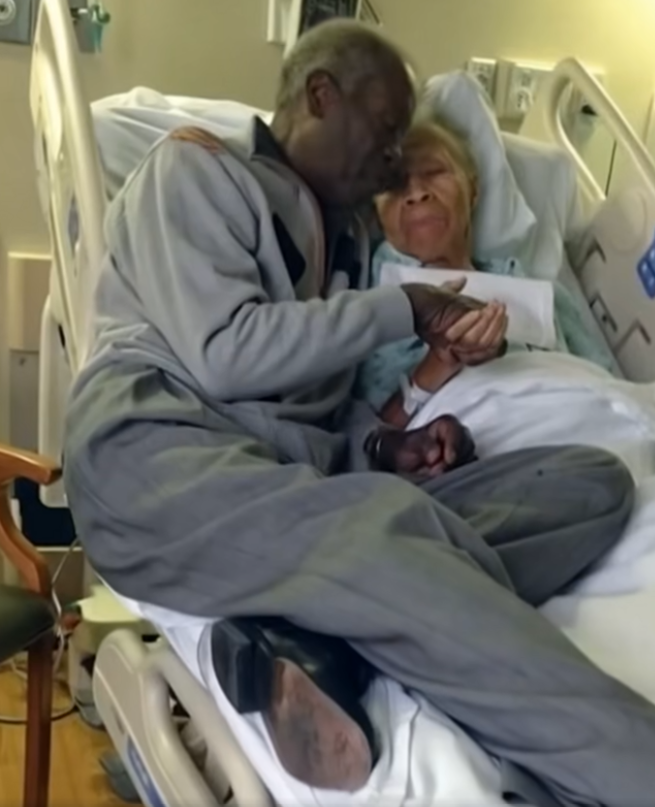
No nurse suggested it. No doctor said it would help her healing. He just did it—slowly, carefully, like it was the most natural thing in the world. Like this was exactly where he was always meant to be.
Right there beside her.
She was tired. You could see it in her face, the way her hands barely held his. But she smiled when he wrapped his arms around her like that. Like decades hadn’t passed, like nothing had changed, even though everything had.
He didn’t care about the beeping machines, the sterile smell, or the uncomfortable angle of that hospital bed. He didn’t care that visiting hours were technically over. He just knew one thing:
She wasn’t going to fall asleep alone.
This wasn’t about flowers or anniversaries or grand gestures. It was about showing up, even when your legs ache and the world’s quiet and nobody else is watching.
Her name was Lidia. His, Marius. They had been married for 51 years. Through every version of life you can imagine—children, miscarriages, tight money, good years, lost jobs, proud moments, funerals, laughter in the kitchen, tears on the pillow—they had stayed side by side.
Lidia had a stroke two weeks before this photo was taken.
It came out of nowhere. One moment, they were having soup together at the little table by the window. The next, her spoon had slipped from her hand. She’d slumped forward. Marius called 112, voice shaking, hands trembling, and rode with her in the ambulance without once letting go of her hand.
The doctors were gentle but honest: it would be a long recovery, and there was no guarantee.
And every night since, Marius was there.
He’d bring a thermos of her favorite tea—linden blossom, no sugar. He’d brush her hair the way she liked it, parting it to the side and tucking it gently behind her ear. He even hummed her lullabies from when their children were babies, hoping somewhere inside her tired body she could still hear them.
That night, though—that photo—was something different.
Lidia had had a hard day. Her speech had faltered again. Her hand, which had started to regain a bit of strength, was limp. She had cried quietly when the physiotherapist left the room. Marius had sat with her, his own eyes red, but didn’t say anything. He didn’t offer clichés. He just held her hand.
And when the nurses started dimming the hallway lights, preparing for night rounds, Marius didn’t move.
Instead, he looked at her, kissed her forehead, then—carefully—he climbed onto the hospital bed beside her.
The bed was narrow, barely wide enough for one. But somehow, it fit them both.
He pulled the blanket up over them. She shifted slightly to lean her head on his chest. And just before her eyes closed, she whispered, almost inaudibly, “You still smell like aftershave.”
Marius chuckled softly. “Same brand, since ’74.”
A nurse, quietly walking by, saw them. She didn’t interrupt. She took a photo instead, with trembling hands and tears in her eyes.
“I just wanted to remember what real love looked like,” she said later.
What the photo didn’t capture was what happened the next morning.
Lidia woke up with more energy than she’d had in days. She managed to lift her fingers and brush them against Marius’s cheek.
A small movement. But monumental.
Weeks later, she was moved to rehab. The therapists were shocked at her sudden burst of motivation. She told one of them, with a playful smile, “He climbed into bed with me. I couldn’t let him down.”
And she didn’t.
She worked. Hard. Through pain, frustration, and fatigue. Marius came every day, sat through every session. Cheered when she could lift her spoon again. Cried with her when she stood for the first time.
But the twist—the one no one saw coming—was Marius’s fall.
It was about a month into her recovery. He slipped in the hospital lobby, right by the coffee machine. Broke his hip. They had to operate.
Now they were two patients, on two different floors.
Everyone worried Lidia would regress without him nearby. But no—something in her ignited.
She insisted on being wheeled to his room. Every single day.
“Just for five minutes,” she told the nurses. “I need to see his eyes. It’s how I know I’m still alive.”
And the day Marius was discharged, still limping, he waited at the hospital entrance, holding a single sunflower.
It was Lidia’s favorite.
She rolled out in a wheelchair, still a little shaky, and when she saw him, she burst into tears.
“I thought I’d surprise you,” he said, grinning. “But I’m pretty sure I’m the one who’s surprised.”
“You still smell like aftershave,” she whispered, laughing through her tears.
They both went home that day. Not fully healed, but together. And that was enough.
The lesson?
Love doesn’t always look like the movies.
Sometimes, it looks like a wrinkled man in old slippers climbing into a hospital bed. Sometimes it’s a woman in a wheelchair asking to be pushed just to see her husband smile.
It’s not perfect. It’s not always romantic. But it’s real.
Real love stays when things get hard. Real love holds your hand in silence when there’s nothing left to say. Real love doesn’t keep score. It shows up. Again. And again.
So here’s to the Marius and Lidia kind of love—the kind that doesn’t quit.
If this story touched your heart, take a moment to like, share, or tag someone you love. You never know who needs to be reminded today:
Real love still exists. 💛