She thought she was just picking up paperwork.
That’s what the school secretary told her. “Just swing by after lunch,” she said over the phone. “A few forms to sign, nothing big.”
She hesitated. It had been months since she left.
The cancer treatments had drained her. The idea of walking those halls—her halls—without the energy to teach felt like salt in a wound. But something told her to go.
She turned the corner toward her old hallway…
And stopped.
They were all there.
Former students. Some in college sweatshirts. Some with kids of their own. Lined up shoulder to shoulder, holding signs, holding flowers—holding back tears.
“Welcome Home, Ms. Carter.”
It was written in bold marker on a giant banner. Someone had recreated her old bulletin board. Another brought in her favorite lavender tea.
And then the music started.
One of her old theater kids—now a music major—began to sing the same song they’d performed together in the school play five years ago. Others joined in. The hall echoed with voices she thought she’d never hear again.
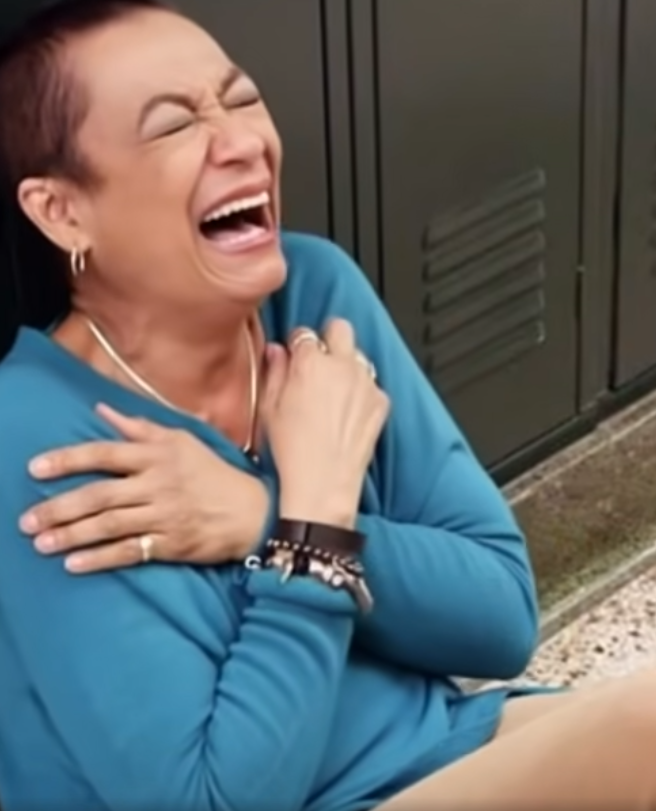
She collapsed to the floor—not out of weakness, but from sheer emotion.
Because in that moment, Ms. Carter realized something:
They hadn’t just learned English, or algebra, or history from her.
They’d learned how to show up.
Tears streamed down her face as warm arms gently helped her to her feet. A former student—Tyrell—held her hand, steady and sure. He used to sit in the back row, hoodie up, barely speaking. Now he was in nursing school.
“Ms. Carter,” he said with a grin, “you taught me how to care, even when I didn’t feel like it. You said, ‘Consistency is love in action.’ I didn’t get it back then, but I get it now.”
Her lips trembled as she nodded, still too overwhelmed to speak.
“I came all the way from Denver,” another voice said. It was Sara, who once struggled with reading and used to stay after school for tutoring. Now she was holding her newborn daughter in one arm and a bouquet of daisies in the other.
“Named her June,” she added. “Because you always said June was the month of growth.”
A gentle chuckle rose from the crowd, followed by a few sniffles.
They moved into the library, where more surprises waited. Photos lined the walls—snapshots from class field trips, spirit weeks, messy science projects, quiet reading hours. Students had sent in memories, notes, and letters.
One poster board read:
“You were there when I wanted to give up.”
Another said:
“You didn’t just teach us to write essays. You taught us to write our own stories.”
In the corner was a worn, leather-bound journal. Ms. Carter opened it with trembling fingers. Inside were pages upon pages of handwritten messages.
“When my parents divorced, you were the only adult who noticed I was hurting. Thank you.”
“I didn’t believe I’d go to college. But you believed for me. I’m graduating this year—with honors.”
“You stayed after school to help me prep for my citizenship test. I passed. I’m a citizen now. So is my mom.”
Ms. Carter looked up, eyes shining. “I didn’t know…” she began.
But another voice interrupted her.
“We didn’t tell you then,” said Daniel, now a high school English teacher himself. “We were kids. But you made a difference, one little act at a time. Showing up. Listening. Loving.”
As the celebration quieted, the school principal—a man who used to be her student teacher—stepped forward.
“Ms. Carter,” he said, clearing his throat, “we know you can’t be in the classroom full-time right now. But we don’t want that wisdom going to waste.”
He pulled out an envelope.
“We’ve started a scholarship in your name. For students who want to become teachers—especially those who need someone to believe in them, like you believed in us.”
Gasps echoed. Ms. Carter blinked in disbelief.
“And…” he smiled, “if you’re up for it, we’d love for you to mentor some of the new teachers. You wouldn’t need to come in every day. We could set up Zoom sessions—whatever works for your health.”
The room was quiet, waiting.
Ms. Carter placed a hand over her heart. “Yes,” she whispered. “A hundred times yes.”
Later, when most had gone and the lights dimmed, she sat in the empty classroom that used to be hers. The walls still had faded outlines where student artwork once hung. She ran her fingers along the desk—still etched with years of love and learning.
A soft knock came at the door. It was a young girl, maybe fourteen.
“I’m sorry,” she said shyly. “I’m in Ms. Tran’s class now. I never had you as a teacher… but my brother did. He told me how much you meant to him. He said you made him feel smart, even when he wasn’t sure he was.”
Ms. Carter smiled gently. “That’s kind of him.”
The girl nodded. “Anyway… I just wanted to say thank you. You don’t know me, but you made a difference. And I’m gonna try and do the same.”
She handed Ms. Carter a bracelet—homemade, with tiny lavender beads.
“For strength,” she said, then disappeared down the hall.
That night, as Ms. Carter lay in bed, she didn’t feel weak.
She felt whole.
She thought of the students who’d stood in her hallway, not just to honor her, but to reflect the very lessons she’d once poured into them: kindness, persistence, and the power of simply being there for someone else.
She hadn’t known if her years in the classroom had meant anything. She didn’t realize that showing up, even when it was hard—especially when it was hard—was what made the difference.
And maybe that’s the lesson in all this:
You never know what seeds you’re planting when you show up for someone.
When you choose to care, to stay a little longer, to listen a little deeper—it matters.
Sometimes the rewards don’t show up in the moment…
…but one day, they might stand in a hallway holding signs and singing your song.
And you’ll know:
You changed the world, one student at a time.
💜 If this story touched your heart, share it. Someone out there needs a reminder that what they’re doing matters. Like this post so more people can see it—and maybe be inspired to show up for someone today.